
Connection diagrams SV701
Basic connection diagram
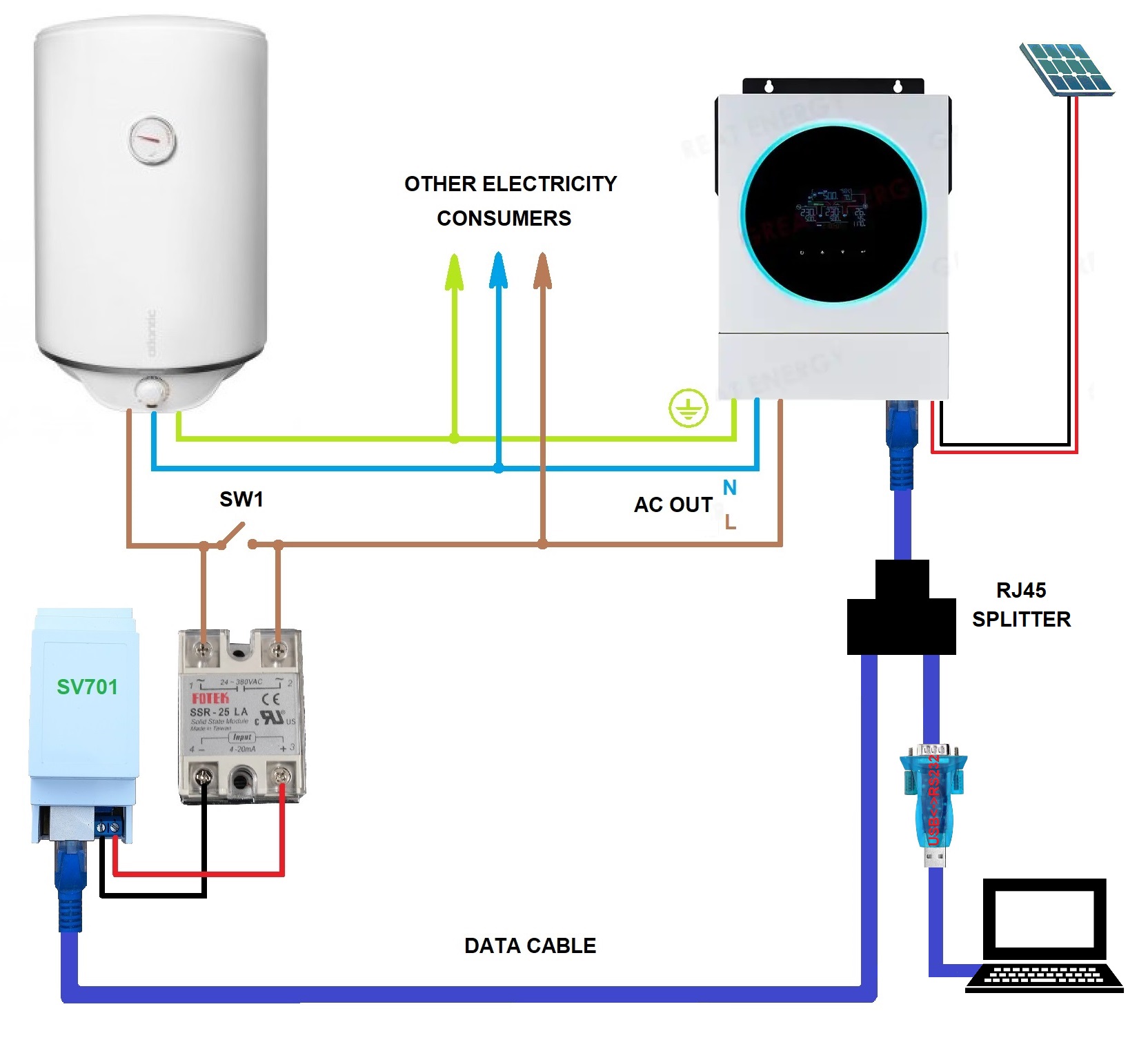
Basic connection diagramSV701shown below. This circuit is suitable for most budget inverters.
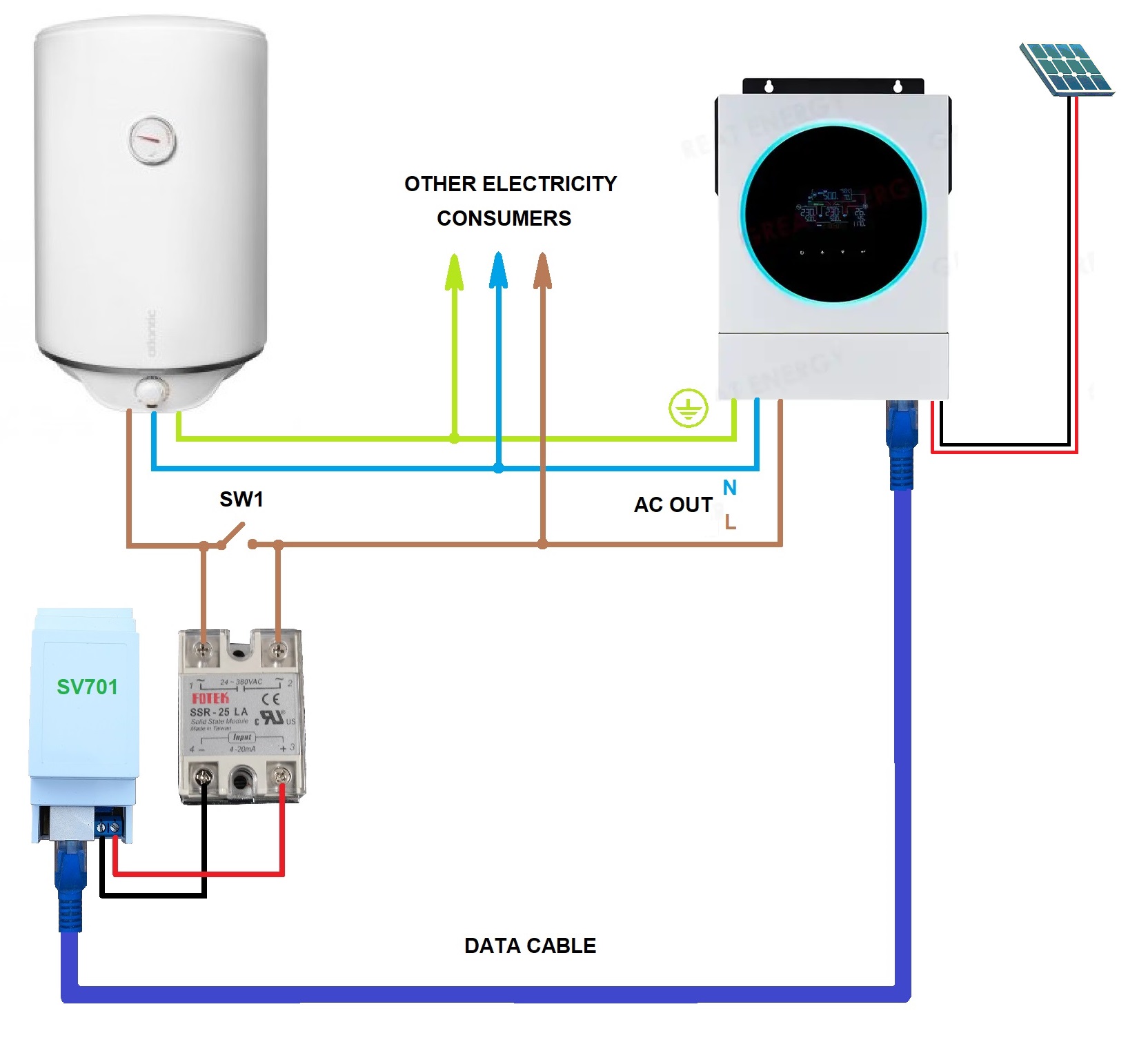
To control power, you need to use a solid state relay (SSR) with an LA characteristic (current regulation 4-20mA). For example, inexpensive FOTEK relays, for example FOTEK 25LA, performed well.Update. Unfortunately, it turned out that this manufacturer uses triacs in its devices that do not correspond to the declared power. Disassembling the 25A and 50A relays showed that there is a 12A triac inside :( Therefore, do not use these relays for powers of more than 2.5 kWYou can also use a relay with a VD characteristic (voltage adjustment 0-10V). For example, relay LCSSR1VD25A. Select a relay that will match the operating current of your load with a margin. For example, in a 230V network for a 2kW boiler, a relay with an operating current of 25A will be sufficient. Links to trusted sellers of such relays and other necessary components and parts are locatedon this page.
Using switch SW1 you can connect the boiler to the network directly. This way it can be used in its usual mode. This may be necessary, for example, on a cloudy day.
For information exchange, the device is connected to the inverter via the RS-232 interface. On the inverter, this port is intended for connecting wifi data loggers likesuchor computers. On most modern inverters, this port is connected to an RJ45 connector.SV701has the same connector with the same pin arrangement, so to connect to the inverter you can use a regular patch cord for Internet connections.
| Inverter side, connector RJ45 | SV701 side, connector RJ45 | ||
|---|---|---|---|
| 1 | TX | 1 | RX |
| 2 | RX | 2 | TX |
| 4 | +12V | 4 | +12V |
| 8 | GND | 8 | GND |
If your inverter has an RS-232 port connected to a standard DB9 connector, then you will have to make a special cable for connection.
| Inverter side, connector DB9 | SV701 side, connector RJ45 | ||
|---|---|---|---|
| 2 | TX | 1 | RX |
| 3 | RX | 2 | TX |
| 9 | +12V | 4 | +12V |
| 5 | GND | 8 | GND |
| Inverter side, connector RJ45 | SV701 side, connector RJ45 | ||
|---|---|---|---|
| 3 | TX | 1 | RX |
| 6 | RX | 2 | TX |
| 2 | +12V | 4 | +12V |
| 5 | GND | 8 | GND |
In any case, before connectingSV701You should check the documentation for your inverter. Perhaps your inverter has a different connector pinout. Please also read this page to the end carefully. Perhaps the connection diagram specifically for your inverter is shown below. Then you will have to make your own cable using or without converters.
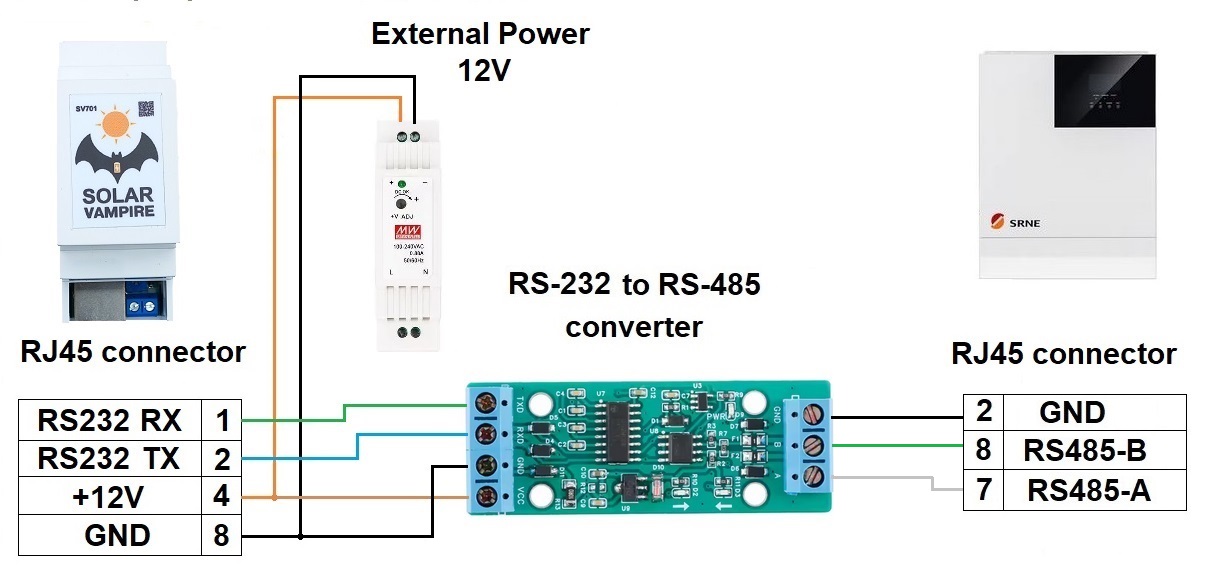
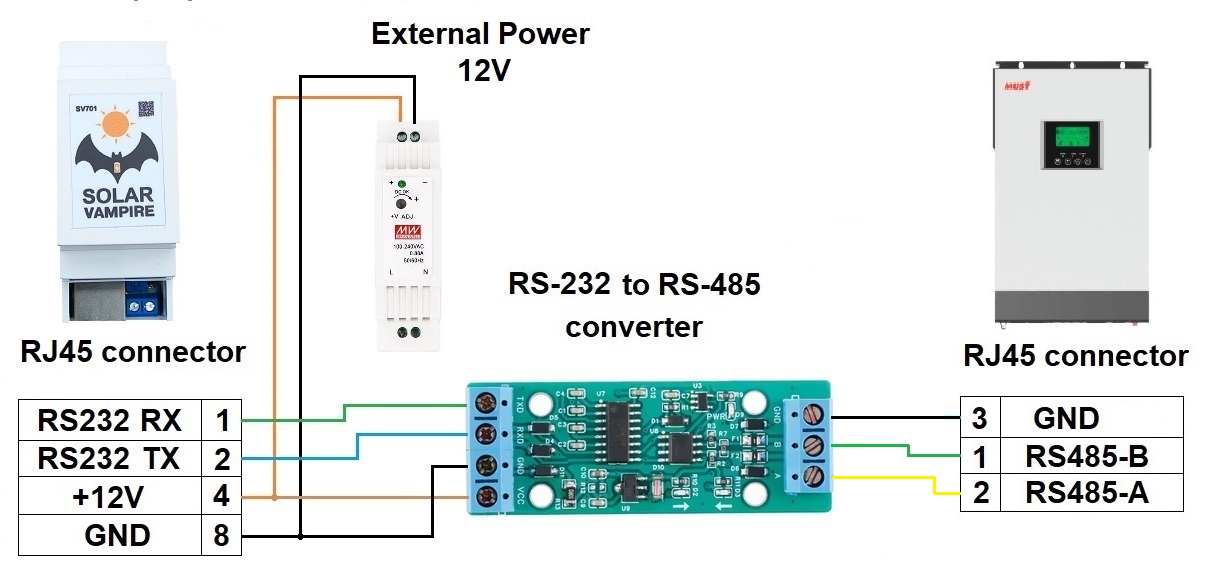
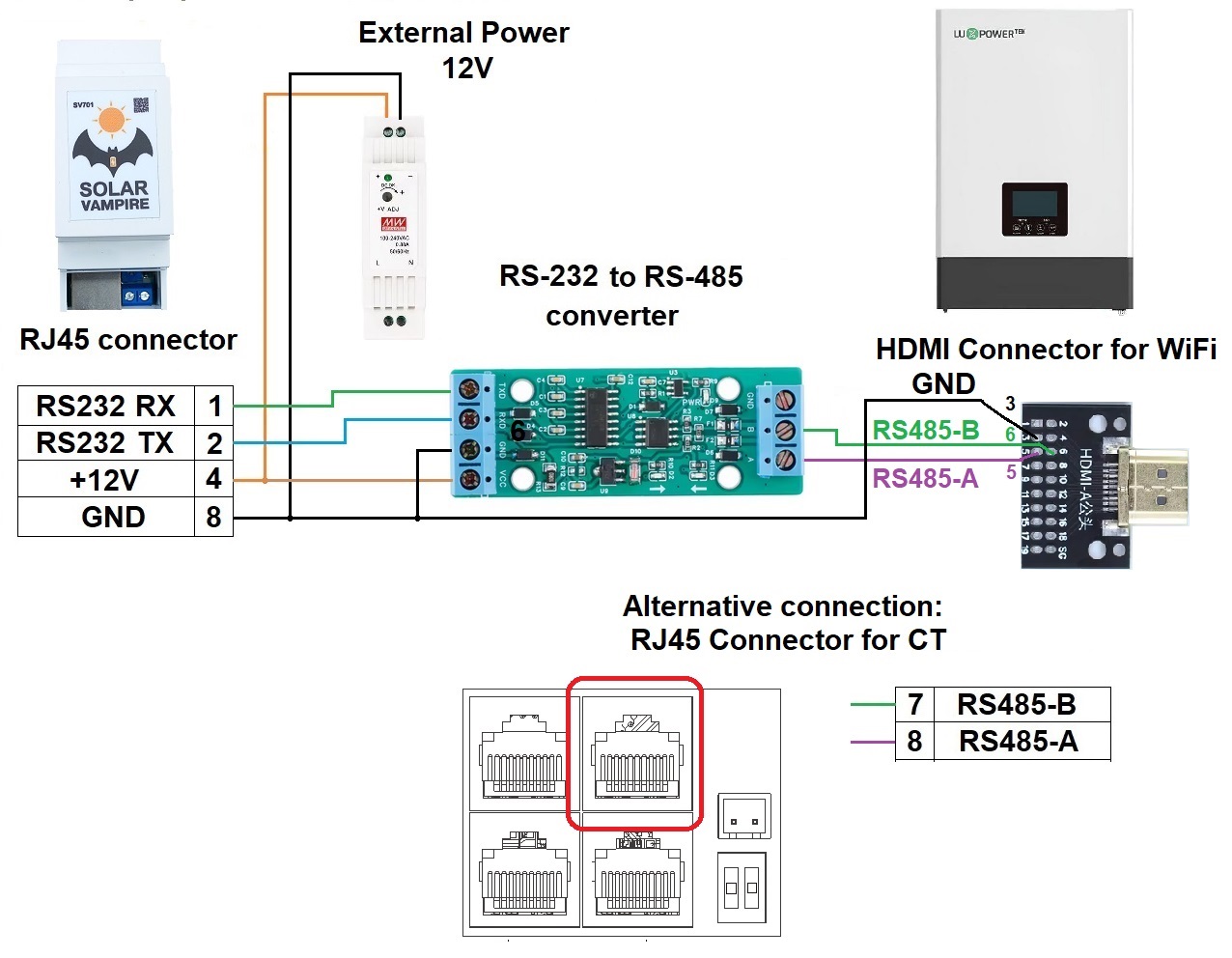
Below are diagrams for connecting various inverters using converters. Other suitable converters can be used. But we have tested these options.
Connection diagram of SV701 to SRNE inverters
Connection diagram of SV701 to MUST inverters
Connection diagram of SV701 to LuxPower inverters
Connection diagram of SV701 to Growatt SPF inverters
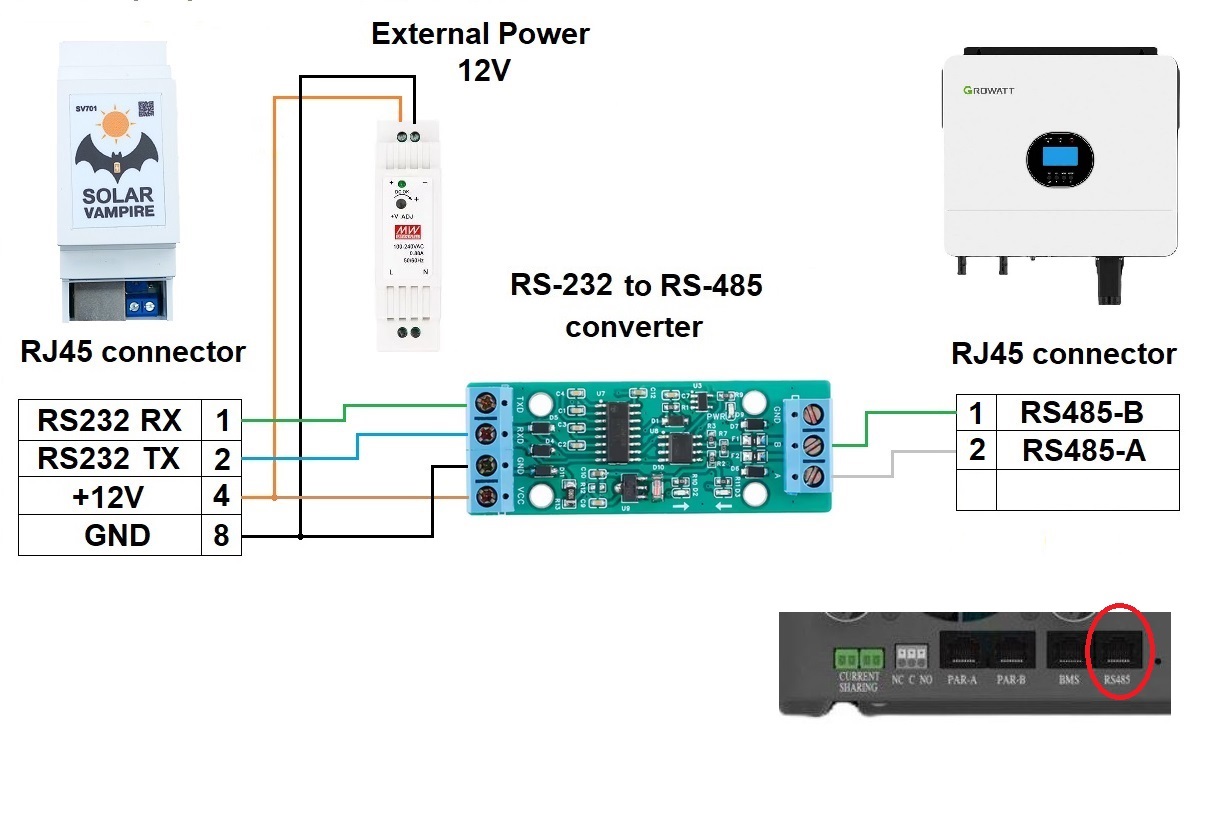
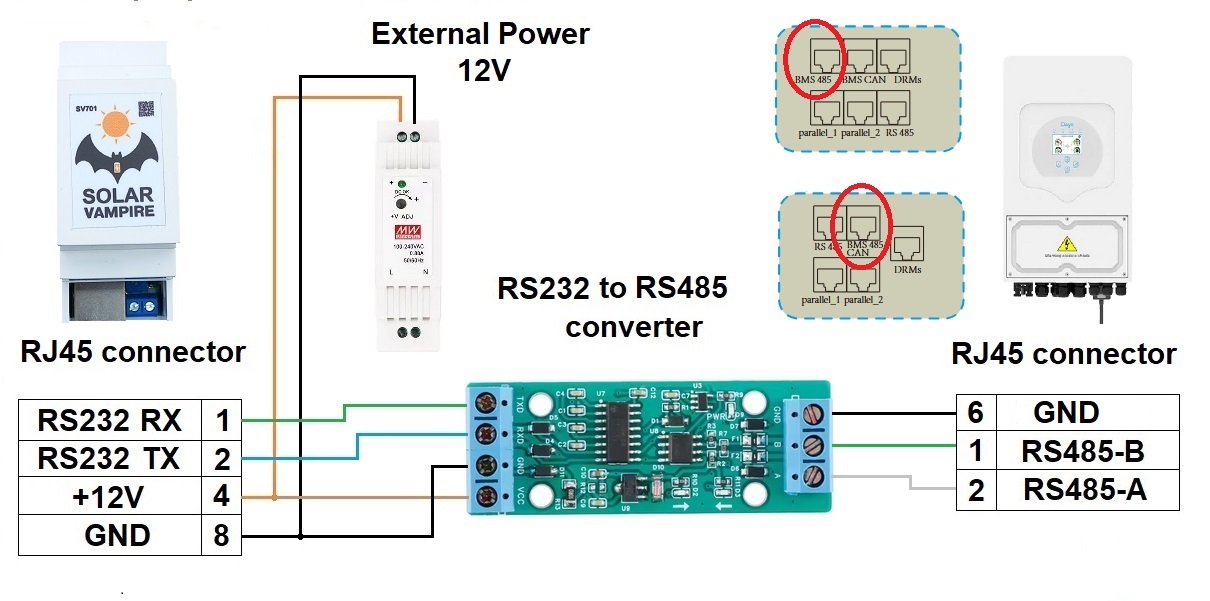
Connection diagram for SV701 to Deye 1phase inverters
These inverters are connected via RS-485 via the BMS connector. Therefore, only the CAN interface remains available to the battery.
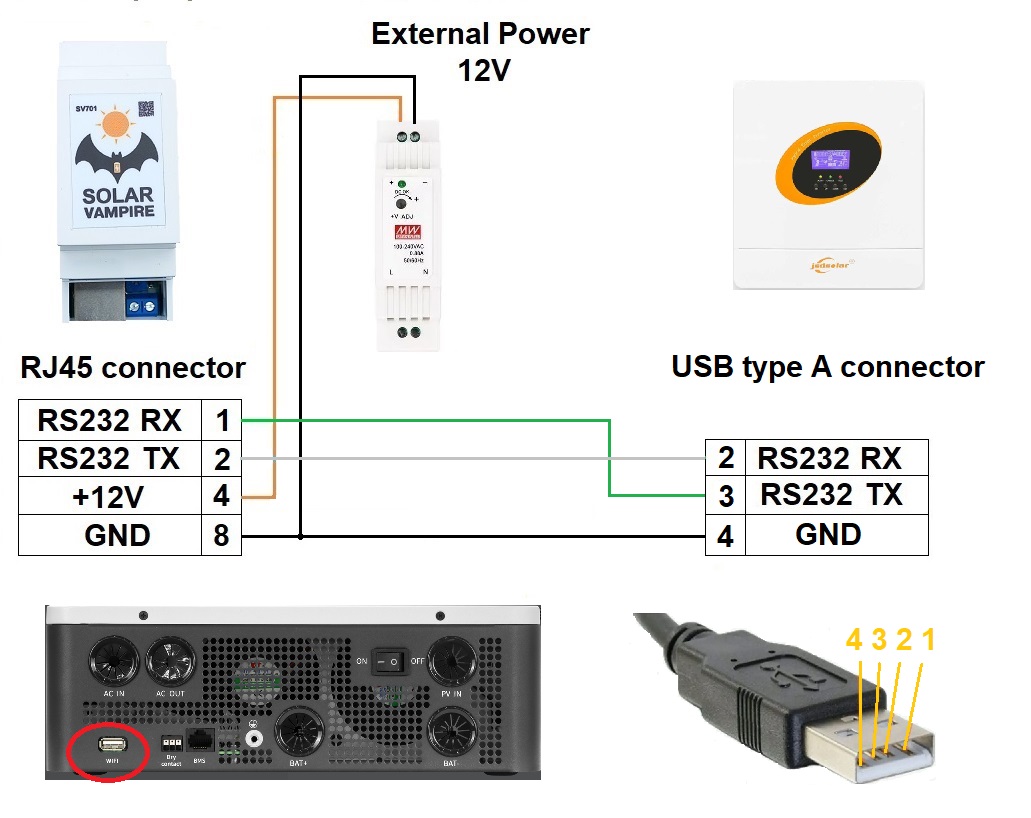
Connection diagram of SV701 to Jsdsolar J4000, J5500 inverters
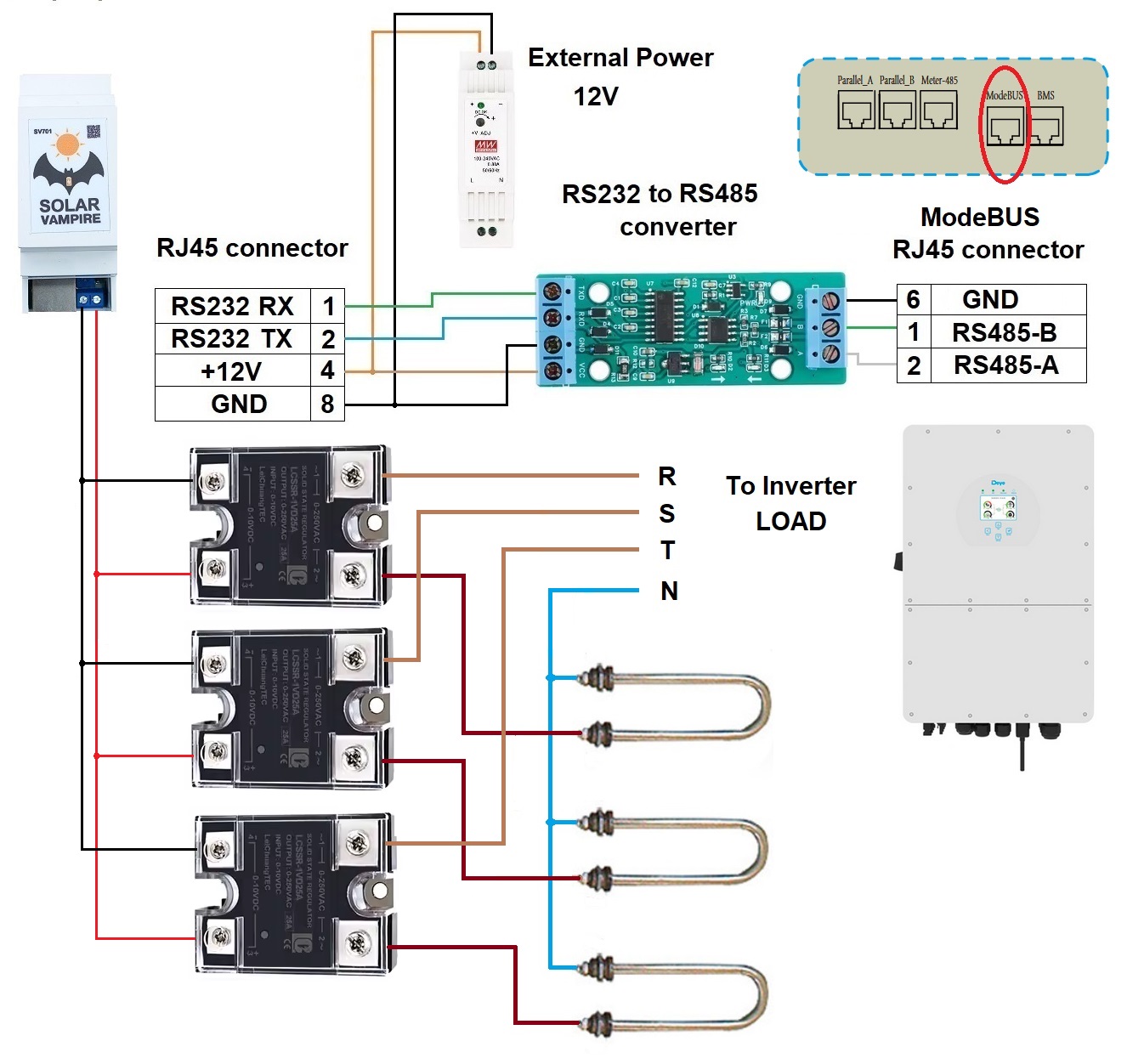
Connection diagram for SV701 to Deye 3phase inverters
These inverters are connected via RS-485 via the ModeBUS connector. To control the load you will needthree-phase relay version.Also for such a relay you will needradiator
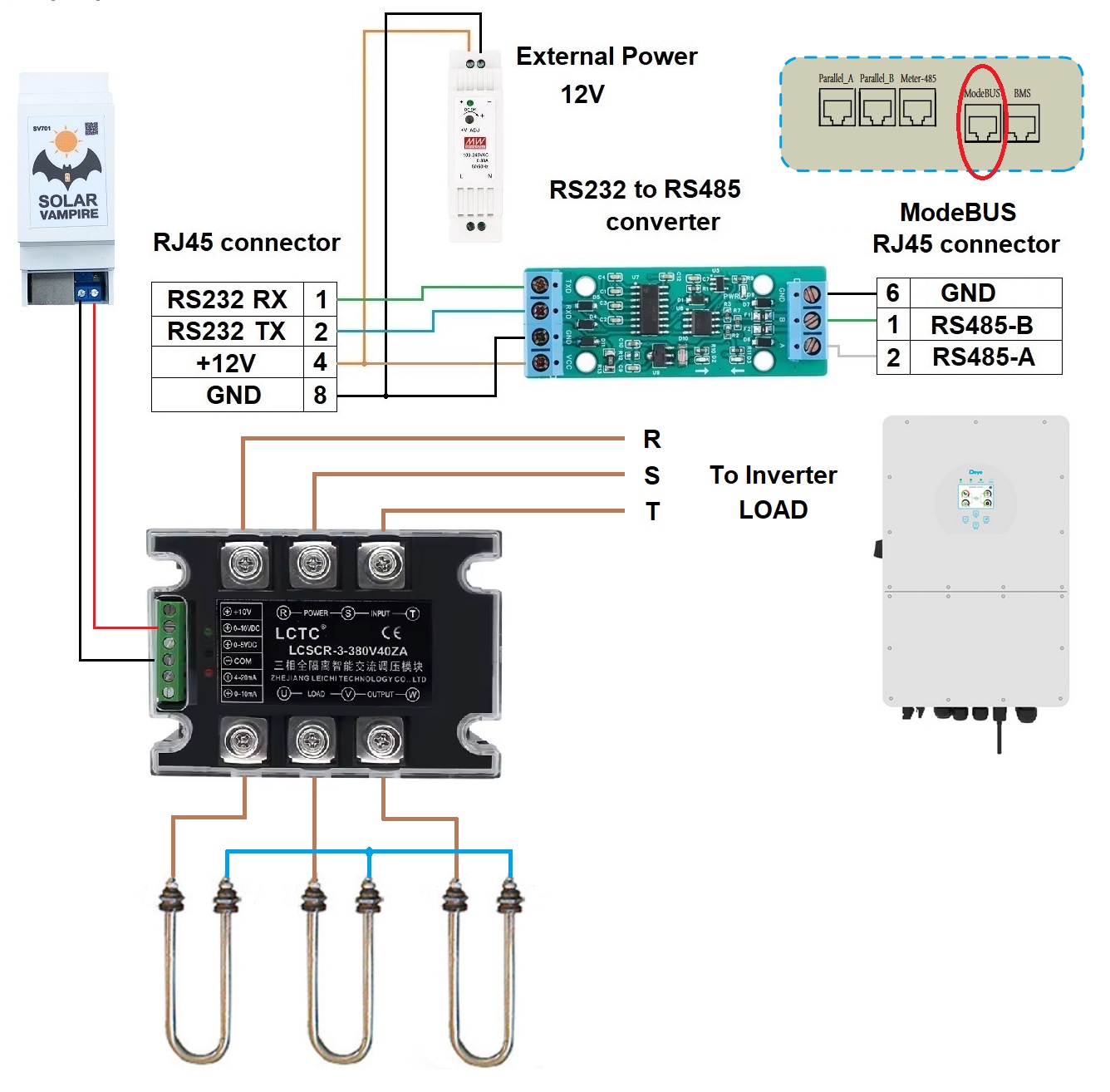
Alternative diagram for connecting SV701 to Deye 3phase inverters
Here are usedsingle-phase SSR relays with VD control characteristic (0-10V).
Parallel connection of SV701 and statistics collection devices
If your inverter is equipped with a single RS-232 or RS-485 port, then it may already be occupied by a Wi-Fi module or other data collection device. In general, these ports allow you to have only one master device (Master) during communication. In our case, such a Master is eitherSV701or wifi datalogger. We have worked out two ways to combine the operation of these devices.
The first method is to use a laptop or tablet running the program to collect statistics instead of cloud servicesMultiSIBcontrol. This program only works with inverters that have the Voltronic&Clones protocol. Such a program collects much better statistics compared to cloud services. After all, it collects data once every 2 seconds, while cloud services poll the inverter once every 5-10 minutes. Thanks to frequent polling, the work of such a program can be combined with workSV701. To do this, you need to connect both devices to the inverter via an RJ45 splitter (all contacts are paralleled) or independently solder such a cable to connect two devices simultaneously. Changed connection diagramSV701shown below.
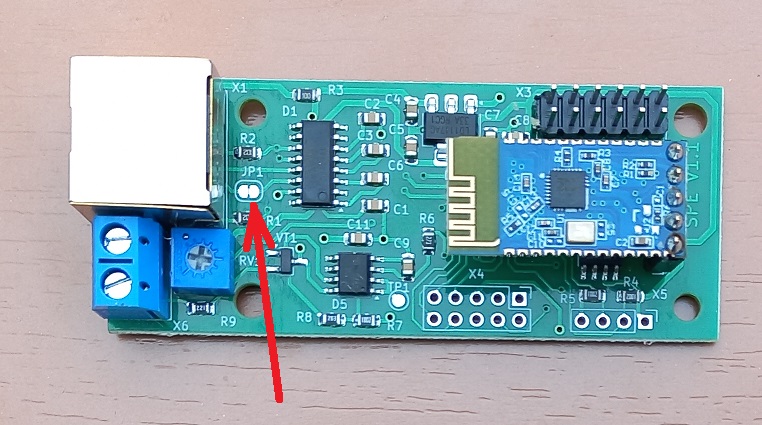
Before switching on the boardSV701you need to cut jumper JP1 (see photo below). This will block our device from sending requests.
Requests will now be sent by a computer or tablet.SV701will “eavesdrop” on the inverter’s responses, extract the necessary information from them and regulate energy consumption.
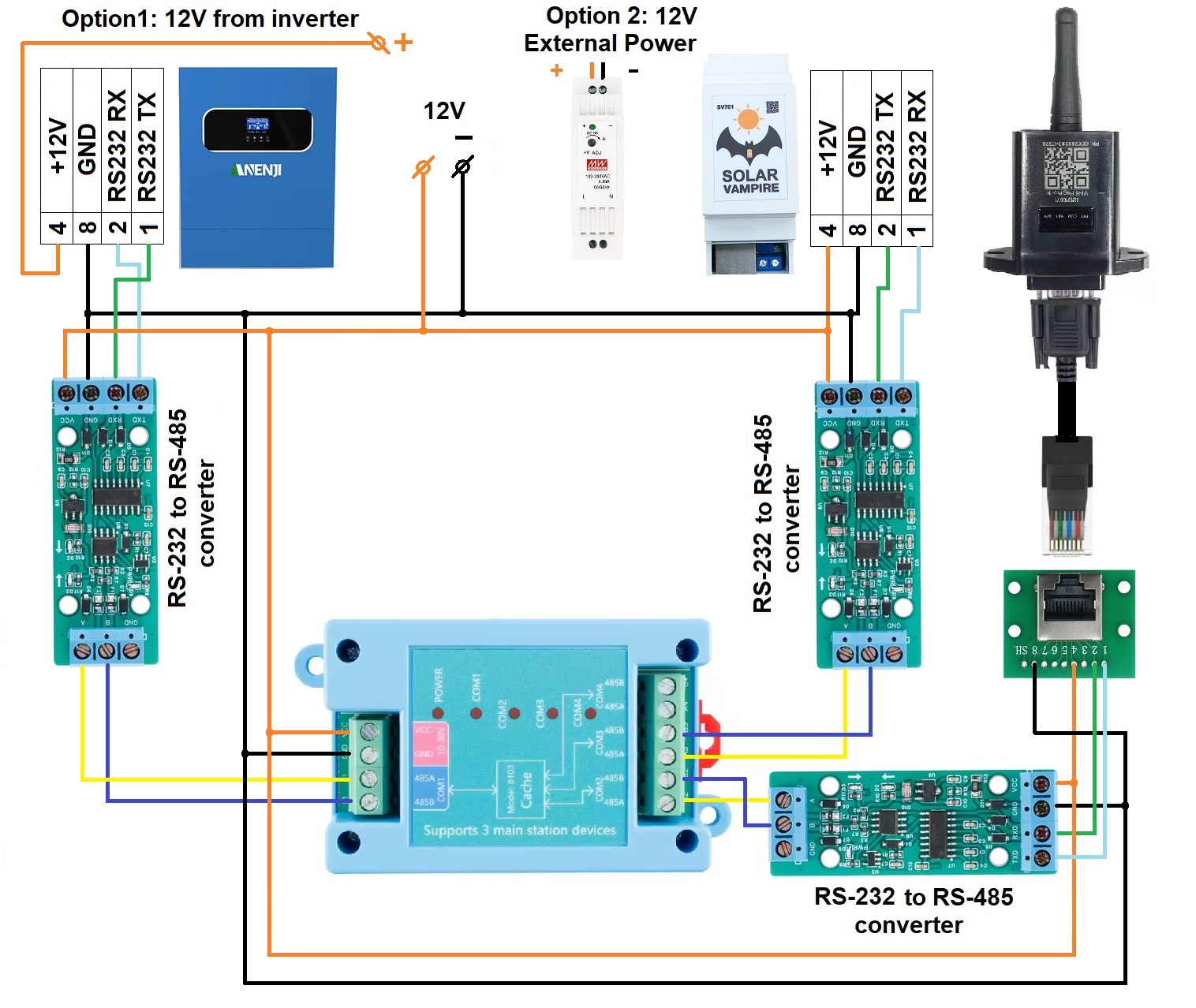
The second way is to connectSV701and wifi datalogger via a special routerYR-8103. This router allows two master devices to poll one slave device quasi-simultaneously. Access conflict is resolved by buffering and staggering requests and responses. This device has an RS485 interface. Therefore, if the equipment has such an interface, then it can be connected to the router ports directly. If the equipment has an RS232 interface, then it must be connected via RS232-RS485 converters.
The connection diagram for inverters with RS232 port is shown below. To power YR-8103,SV701, wifi datalogger and converters can use 12V power from the inverter. For example, the Anenji 4kW inverter “pulls” such a load. An alternative solution is to supply power from an external power supply.
For inverters with an RS485 port, the circuit is simpler. The connection diagram for SRNE inverters is shown below as an example.

In addition to wifi dataloggers, you can also try combining workSV701and other statistics collection devices. Below is an example of a joint connection diagramSV701and Solar Assistance.
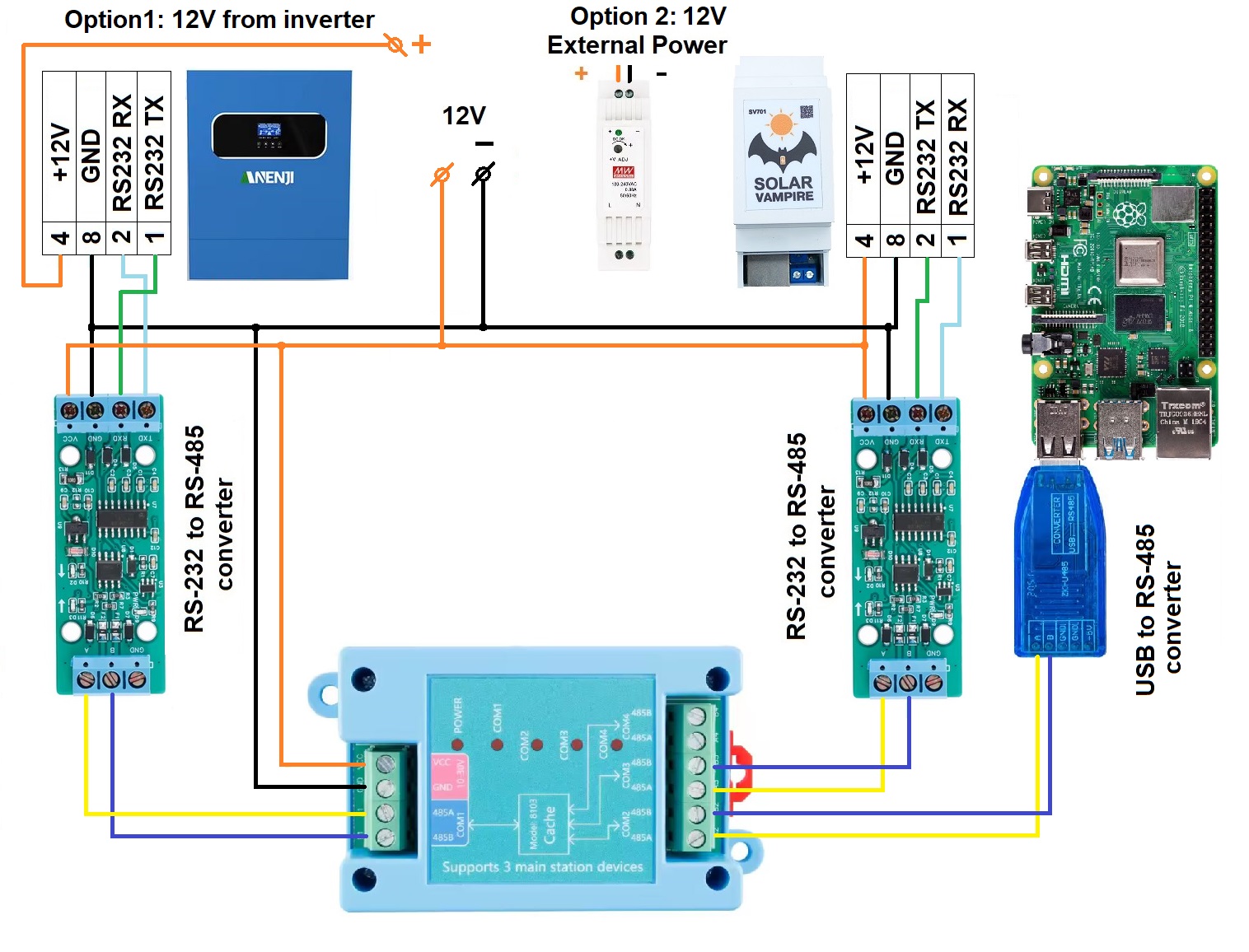
The YR-8103 does not have auto speed adjustment. From the factory, all device ports are set to 9600 speed. This speed is suitable for Anenji and SRNE inverters. Must inverters require a speed of 19200. Most other inverters have a speed of 2400. Configuring the router is quite simple. You need to connect the router to the PC viaUSB-RS485 converter. We connect the corresponding RS485A RS485B wires on the COM1 port of the YR-8103 router and on the converter. For PC you need to download the configuration program. In thisarchiveThere are instructions and programs with Chinese and English interfaces. We launch the program on the PC. Select the COM port number that corresponds to the USB-RS485 converter. Then we supply power to the YR-8103. Now you need to press the CONN button within 5 seconds. The program will contact the device and show its configuration on the screen.
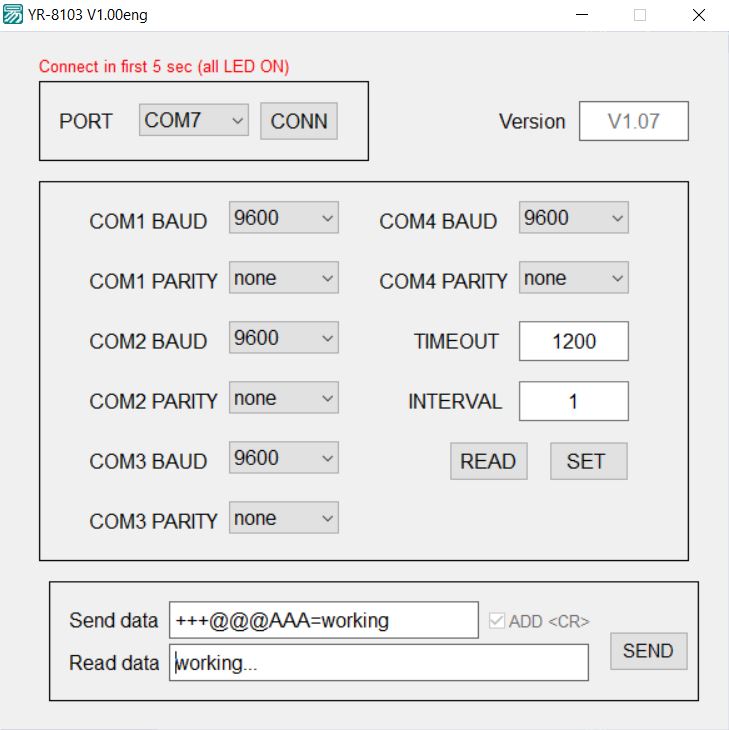
After this, you need to change the speed on all ports to the desired one. Also, if necessary, you can change the Timeout and Port Polling Interval in ms. After changes, you must press the SET button. After this, you can turn off the power and assemble the working circuit.
Below is an example of how such a system works. SV701 sends requests every second. The data logger makes several requests in a row every 5 minutes. The path of requests and responses can be traced by the LEDs on the converter boards.
Connection diagram for SV701 to LCD
The SV701 device can display its operational information on the LCD screen. Here's what it looks like on our test system.
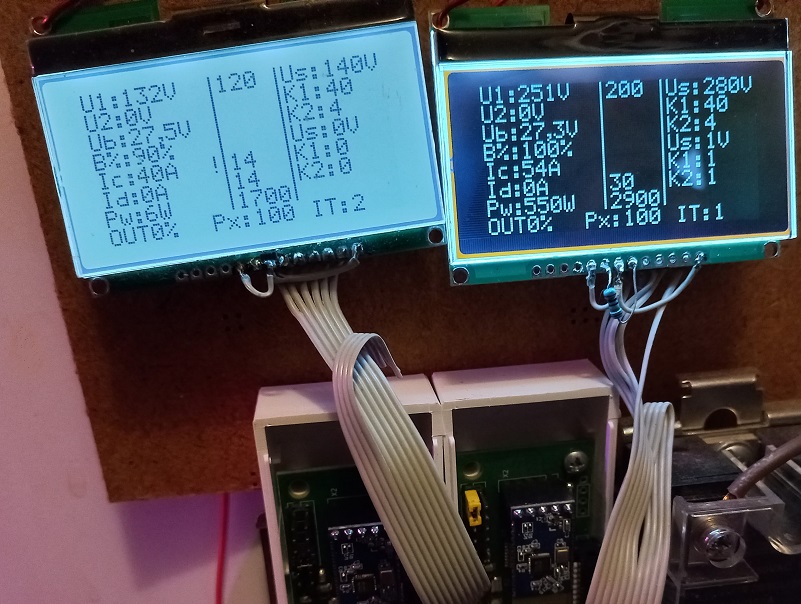
If you wish, you can connect a similar LCD to your device. The connection diagram is below. Unfortunately, we cannot yet offer a ready-made device case for this option. You will have to make it yourself.

Disclaimer
We warrant that our equipment will perform as described on this website when properly installed and used.
However, responsibility for correct assembly, connection and use rests entirely with the user. We are not responsible for equipment damage, system malfunction, loss of data, or other damage caused by failure to comply with instructions, use of the device in unsuitable conditions, or tampering with the design.
Use of our kits is at your own risk. Before you begin, make sure you understand all aspects of the system assembly and subsequent operation. In case of doubt or lack of experience, we recommend seeking professional help.